Monday, February 20, 2023

How have Nike created a game changing ball?

Nike have produced plenty of different types of footballs over a long period of time. They are one of the best-selling companies for footballs. Every year they come up with a new design and each year there are improvements to the design to improve the movement and flight of the ball. This year the ball that they have launched is called the 'Nike Flight Ball'. Nike have said that this new ball has been designed in such a way that it will produce '30% truer flight than its Nike predecessor'.


Nike have deemed the research behind this ball is an eight year investigation into improving the consistency of the flight produced by the football flight. There were three stages behind the development of this ball. The stages were 'Explore, Recreate and Innovate. Nike have changed the design by introducing the new 'Aerowsculpt Technology' ; this has been designed by creating grooves around the ball. This was done in order to improve its speed and flight whilst in mid-air.

The 'Explore' phase involved using various types of tracking systems which measured the flight of the ball during different styles of kicking the ball. The tests involved bringing professional footballers and testing their styles of kicking the ball. 

The 'Recreate' phase involved replicating kicking styles observed on the pitch with a robotic leg. This way of testing allowed them to repeat it plenty of times. With this way of testing, Nike could compare a large set of different balls and see what was required to make the new 'Nike Flight Ball' better than its predecessors. 

The 'Innovate' phase involved testing the ball with 68 different iterations. This process took over thousands of hours in the lab. This shows how keen Nike were to create a ball that was far superior with its aerodynamics than its predecessors. Nike also brought in 800 professionals to test these different iterations; this allowed them to create a final version. 

The main difference that was clearly visible which was the introduction of the grooves in the ball. This was to reduce the wobble and enabled it to provide more consistent and predictable flight. The design of the grooves were improved over the 68 different iterations. The main intention was to promote a more stable flight. In my opinion, the final design with the grooves in the ball is a very remarkable thought as it provides the ball better aerodynamics and allows the ball to have a stable trajectory towards its target. 

Another benefit of this new ball is that it will be easier to get curl on a shot. With previous balls, the flight of the ball wasn’t always too stable and wouldn’t curl to its maximum ability. Whereas with this new ball, due to the more stable flight, the ball is able to curl into positions where the player kicks it. This enhanced feature is very useful while taking free kicks as players have to curl the ball around the wall of defenders. 
Free kick technique

In the picture above it shows the technique of how to take a free kick. With the new ball, this technique can be performed more easily. The new ball features moulded grooves to prevent inconsistencies in flight which as I mentioned earlier improves shot accuracy. 

Sunday, October 2, 2022

How do the wings generate lift ?


Have you ever wondered when you look through the window of an aircraft about how the wings work? What they're made out of? What makes them suitable for providing a lift?

Aeroplane wings are made out of a specific type of aluminium, an alloy that offers a combination of lightness and strength comparable to steel that makes for easy flying. Wings are a critical part of aeroplanes because they are used for lifting, turning, landing, and controlling the aeroplane. Without wings, aeroplanes simply could not fly. For a plane or bird to fly, its wings must produce enough lift to equal its weight. Most wings used in flight are of a special shape – called aerofoils (or airfoils). This shape allows them to generate lift.

Newton’s third law of motion states that, for every action, there is an equal and opposite reaction. It is said that wings follow the same principle. Following the principles of this law, the wings are forced upwards because they are in a tilted position, pushing air downwards so the wings get pushed upwards. This is the angle of attack or the angle at which the wing meets the airflow.

It can be represented more like this - The action of the wing on the air is to force the air downwards while the reaction is the air pushing the wing upwards. A wing's edge must be sharp, and it must be aimed diagonally downwards to create lift.

The amount of lift depends on the speed of the air around the wing and the density of the air. To produce more lift, the object must speed up or increase the angle of attack of the wing which can be done by pushing the aircraft’s tail downwards. The angle of attack has a limit; if it is too large, the flow of air over the top of the wing would no longer be smooth and the lift suddenly decreases.

Monday, June 27, 2022

What are the principles behind aerodynamics of Formula One (F1 cars)?

F1 cars are required to move much faster than ordinary cars. To do this, changes are made to the structures of F1 cars. This also applies to other racing cars but here we’ll talk more about F1 cars as their structures are unique. The whole game is all up to how we can improve the aerodynamics of the car.

Two key components that play a big role in aerodynamics are drag and downforce. Drag is the amount of air resistance and airflow, and how it affects car performance. Downforce is how the car sticks to the floor, and the gravity acting on it.

If you reduce the drag of the car, it will go faster on the straights of the circuit. F1 cars are designed with the smallest possible frontal area to minimise drag (friction). This makes the body of the car more streamlined and allows it to cut through air faster. If you can use the shape of the car to generate some downward pressure (downforce) onto the tires, then the car will go faster around the corners of the circuit. Every F1 car is fitted with a variety of wings, splitters and diffusers, which direct air over and around the car in a controlled and uniform manner. They work on fundamentally the same principles as an aeroplane wing, except in reverse, pushing the car down on to the track to maximise tyre traction, particularly when cornering. Formula 1 cars use wing elements to generate down-force, however Aircrafts use their wing elements to generate lift. By flipping the front and rear wings upside down, it will apply pressure downwards keeping the car pushed towards the ground. The faster the wind moving over the wings, the more downforce pressure gets applied.

Each season, the motorsport governing body, the FIA, issues technical regulations with intricate details on car design, from width and height to thickness and weight. This means all racing teams have to design a new car each year to match the rules. This also means that the teams have to come up with new ideas for improving aerodynamics. Even the slightest of changes can improve lap times and allow the car to go faster than the other cars. Examples include car width, tire size, wing dimensions etc.

F1 teams use two main tools for aerodynamic research and development - wind tunnels and a computer analysis system known as computational fluid dynamics (CFD). CFDs allow teams to render virtual models of the actual car. With these virtual models they can test how fast the car can go and how to optimise each and every part of the car so that it improves the overall aerodynamics of the car. A wind tunnel is a tool used in aerodynamic research to study the effects of air moving past solid objects. It consists of a closed tubular passage with the car to be tested mounted in the middle. A powerful fan system moves air past the car. In CFD, the same experiment ( wind tunnel ) may be conducted in the form of a computer simulation


F1 Car in the Wind Tunnel                                       CFD simulation      

Friday, April 15, 2022

Some Interesting Facts About Aeronautics


Sir George Cayley is considered to be one of the most important people in the history of aeronautics. As an English engineer, inventor and aviator he is viewed as the first scientific aerial investigator. He was one of the first people to understand the principals of flight. Even back in 1799 he founded the concepts of a modern aeroplane in that it needed separate systems for lift, propulsion and control. Regarded as the ‘father of aviation’ his impact is long-lasting and telling. 


This is the astronaut Tim Peake. Tim was the first British ESA astronaut to visit the International Space Station, launching on a Soyuz rocket on 15 December 2015 with crewmates Tim Kopra and Yuri Malenchenko. His Principia mission was an eventful and busy six months in space. In the first month, Tim conducted a spacewalk to repair the Station's power supply. Other highlights of his mission saw him drive a rover across a simulated Mars terrain from space and he helped dock two spacecraft. [Ref: https://www.esa.int/Science_Exploration/Human_and_Robotic_Exploration/Astronauts/Timothy_Tim_Peake]


BAE Systems (BAE) is a British multinational armssecurity, and aerospace company. Its headquarters are in London and Farnborough in the United Kingdom with operations worldwide. The company is the largest defence contractor in Europe and among the world's largest defence companies; it was ranked as the third-largest based on applicable 2017 revenues. 

BAE Systems' first annual report identified Airbus, support services to militaries and integrated systems for air, land and naval applications as key areas of growth. It also stated the company's desire to both expand in the US and participate in further consolidation in Europe. BAE Systems described 2001 as an "important year" for its European joint ventures, which were reorganised considerably. The company has described the rationale for expansion in the US; it is by far the largest defence market with spend running close to twice that of the Western European nations combined.


British Army Dirigible No 1, christened Nulli Secundus was a Semi-rigid airship. First flown on 10 September 1907, it was Britain's first powered military aircraftTwo flights were made: during the first, the airship was flown for around three miles at a height of about 200 ft. The flight being terminated by an engine fault. A second flight was made later in the day, the propeller blades having been reduced in area in order to increase their speed of revolution.

A more public appearance was made on 5 October, when it was flown from Farnborough to London. Taking off at 11:00 pm and crewed by Capper, Cody and Lieutenant Waterlow, they made a tour over the city, taking in Whitehall and Buckingham Palace, and after circling St Paul's Cathedral, they attempted to return to Farnborough, but 18 mph (29 km/h) headwinds forced them to land at the Crystal Palace, Sydenham. The flight had lasted for 3 hours and 25 minutes and covered 50 miles (80 km) overland.


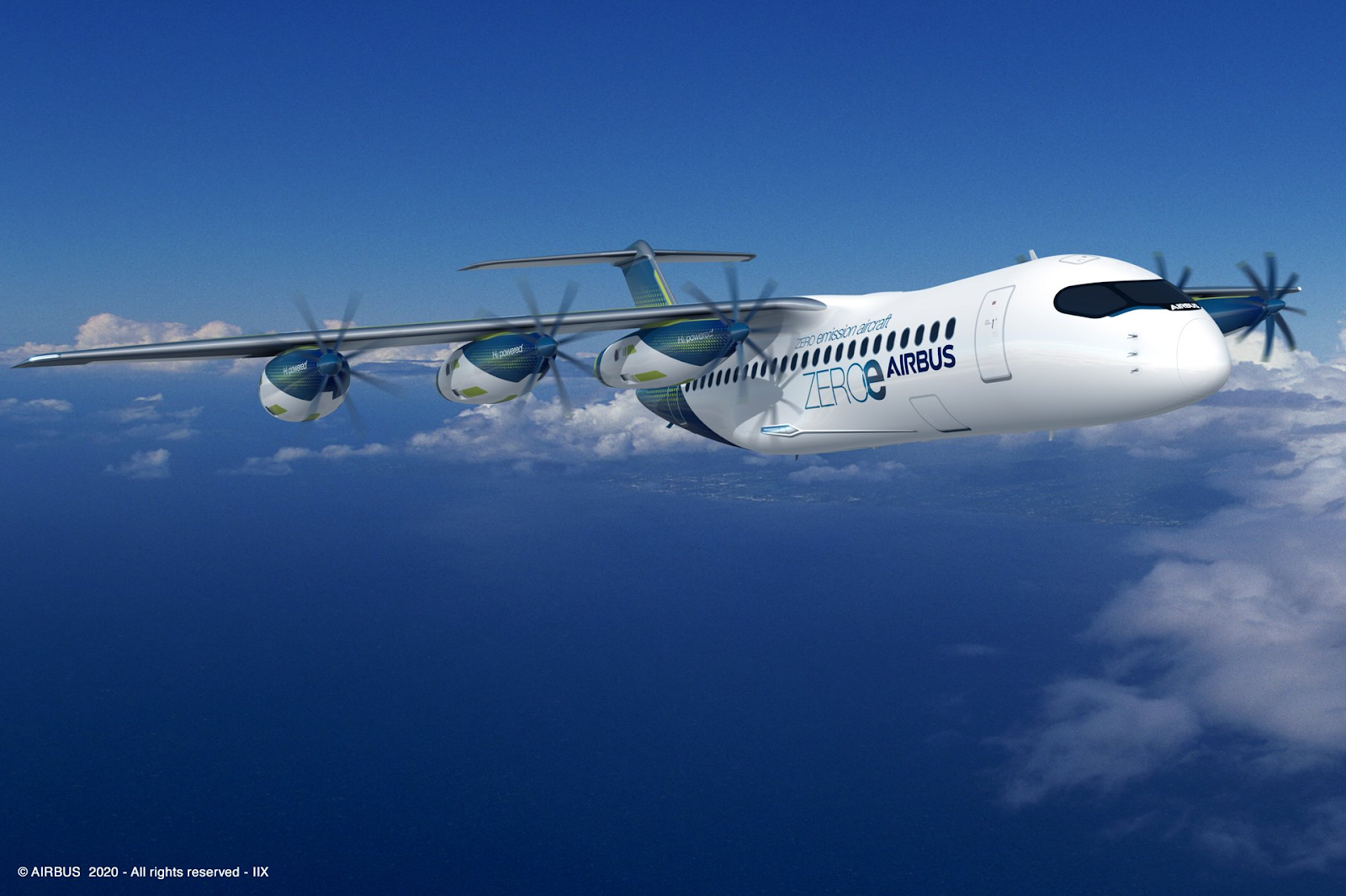
What is the Airbus ZeroE?

Airbus envisions a future of zero-emission aircraft powered by hydrogen-based fuel and electric batteries. They have unveiled three concept ...